Now — Julian Rubisch
What's in the works


ImPulsar4

Read more

ImPulsar4 uses the QS Regular Matrix, a 1970s algorithm for encoding four audio channels onto two, as an instrument of displacement. A quadraphonic recording is folded down to two channels, seeded with interference, then unfolded back to four; what returns sounds almost like the original, but subtly wrong. Spatial certainty is gone, and what should be here appears there.

Play the interactive web piece ↗

Past Tense

Read more

Exploring Idleness and Boredom as Compositional Strategies

Past Tense is a participatory, long-term sound installation inspired by “idle” games—systems that evolve on their own and invite only occasional interaction. Small sounds captured from the environment, electronics, radio, and visitors slowly accumulate, forming a growing sonic mass. Participants may briefly intervene, releasing short sonic gestures before the system settles back into its autonomous flow. Through gradual feedback and repetition, the work invites a relaxed, daydream-like mode of listening and composing, in which past sounds resurface, and the work unfolds from a small kernel of inputs over time.

Interweaving

Read more

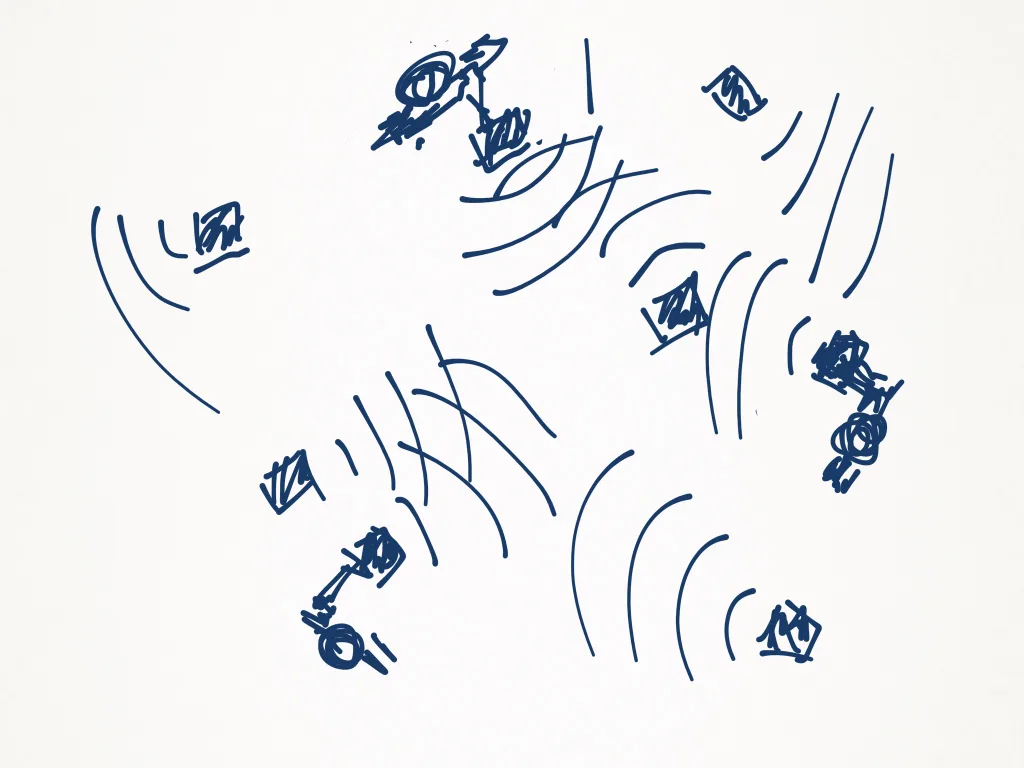
An installative radio art performance that turns live emissions from pulsars, planets and moons into invisible, drifting sound sources. Performers and audience carry wireless loudspeakers shaped like deep-space probes and hunt these signals through the room, collectively "tuning" a meta-instrument made of the whole space. A collaboration with Tobias Leibetseder.

Interweaving — probe-shaped wireless loudspeakers

Bifurcation

Read more

Every piece in it was developed entirely from a single equation: the logistic map, the famous bifurcation curve. Samples, modulation curves, filter trajectories, everything unfolds from one conceptual core.

Upcoming: Sonic Saturday 2026 (Ars Electronica Festival), Sonic Lab, Anton Bruckner Privatuniversität Linz — 11.9.2026

View this post on Instagram

A post shared by @programmverdichter

Presque Rider

Read more

tries to approach the concept of a “score” in the spirit of casual gaming: Two to three performers battle for victory in a “racing game” by completing electroacoustic challenges that are analysed in real time.